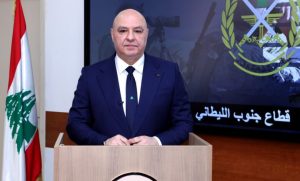
In his first Independence Day address as President of the Republic, Lebanese President Joseph Aoun delivered a clear political vision centered on strengthening state sovereignty and restoring its authority across all territories, while emphasizing the importance of achieving lasting stability both domestically and internationally.
The speech began with a focus on southern Lebanon, described as the testing ground for the state’s ability to assert its decisions and repair the damage caused by decades of aggression and absence of authority. Aoun stressed that no national revival can be achieved without a strong state capable of fully imposing its legitimacy.
The President highlighted the need for transparency as a gateway to rebuilding trust between the state and its citizens. He warned that the previous presidential vacuum was a model of what must be avoided, particularly given the sensitivity of the current regional and international context. Lebanon, he said, is living through a moment reminiscent of its first and second independence, making the consolidation of state institutions and stability a decisive priority.
Aoun cautioned against denying ongoing transformations or marginalizing certain Lebanese communities, noting that such actions threaten national stability and undermine sovereign decision-making. He underscored that the state is the sole umbrella for all Lebanese, and that tampering with this reality risks destabilizing the nation.
The President also made clear that choosing the path of the state means ending all forms of duality in decision-making, whether related to arms or political loyalties. He insisted that decisions of war and peace must remain exclusively within legitimate institutions, reflecting his commitment to safeguarding Lebanon’s security and political stability. In this context, he reaffirmed Lebanon’s strict adherence to the ceasefire agreement along the southern border and praised the role of Lebanese armed forces in implementing the November 2024 accord.
Aoun pointed to two pivotal developments shaping Lebanon’s future. The first was the United Nations Security Council’s ratification of the Gaza Agreement, which he described as a signal of shifting power balances in the region. second, the President underscored the evolving relationship with Syria, aiming to restore ties on an equal footing that bolsters both regional and domestic stability. He placed Lebanon’s economic recovery—driven by stricter monetary management—within the broader context of institutional and financial stabilization, noting that these efforts continue despite campaigns targeting official institutions, particularly the Central Bank.
In the most direct section of his address, the President unveiled a clear initiative concerning southern Lebanon, structured around five key points:
- The Lebanese Army will assume control of occupied positions immediately upon Israeli withdrawal.
- Armed forces will commit to deployment once violations cease.
- The Quintet Committee will be tasked with verifying that Lebanese authority alone is exercised south of the Litani River.
- Lebanon is prepared to negotiate a framework for a permanent cessation of hostilities.
- An international support track will be launched to drive reconstruction and strengthen the army’s capabilities, ensuring that arms are confined to the state across all territories.
This initiative reflects the President’s determination to consolidate stability through state institutions rather than temporary or ad hoc solutions.
He concluded by framing the current struggle within the concept of a “renewed independence,” affirming that stability is not merely a slogan but an integral part of a comprehensive state project—one built on law and institutions, safeguarding citizens, and restoring Lebanon’s standing in its regional and international environment.