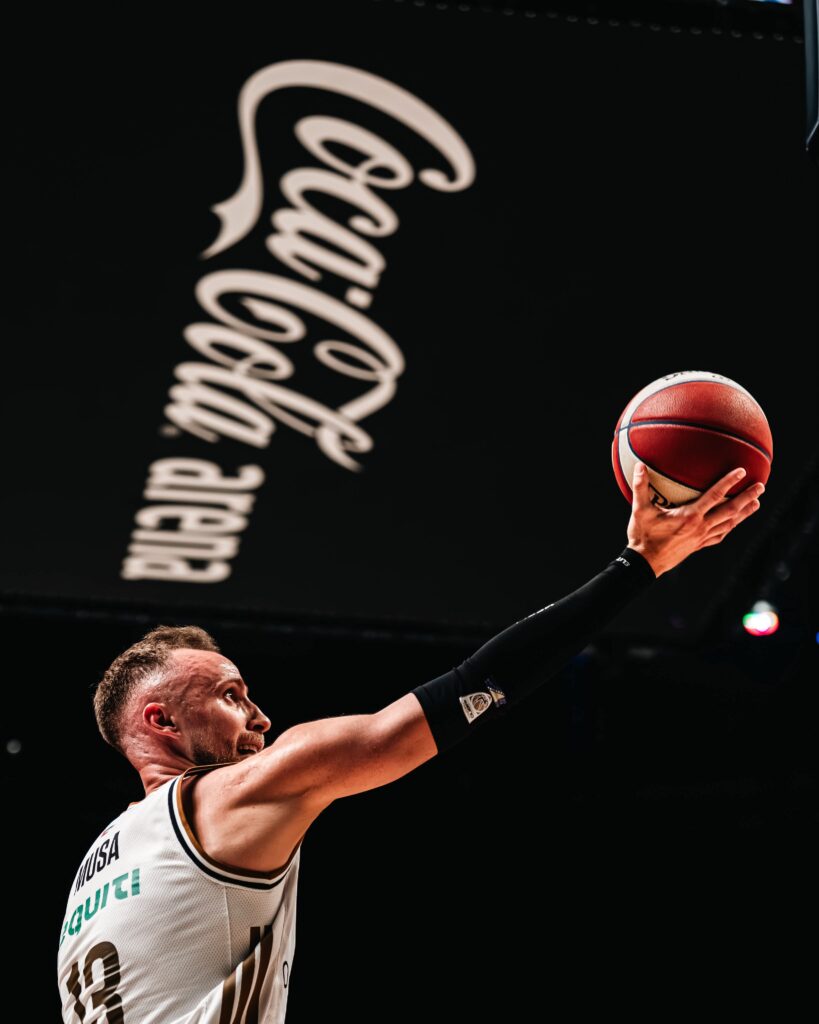
In a significant evening for basketball in the United Arab Emirates, Dubai Basketball Club opened the ABA League finals with a composed and authoritative 99–93 victory over Serbia’s Partizan Mozzart at Coca-Cola Arena. The occasion marked the team’s long‑awaited return to home court following recent regional developments, and the response from the public was emphatic: the largest crowd in the club’s history filled the arena, creating an atmosphere that spoke not only to sporting enthusiasm but to Dubai’s broader sense of continuity, resilience and civic confidence.
Dubai approached the contest with a level of tactical clarity and structural discipline that reflected the club’s rapid progression on the European stage. The hosts established control early, taking the first quarter 29–24 and extending their advantage in the second period 24–20. Partizan, drawing on their considerable European pedigree, mounted a determined response in the third quarter, narrowing the deficit 22–16 through improved defensive cohesion and more assertive ball movement. Yet Dubai regained command in the final quarter, closing the game 30–27 with a blend of composure, defensive organisation and timely scoring. Their ability to withstand pressure, recalibrate their defensive shape and reassert offensive rhythm demonstrated a psychological maturity that has become increasingly evident this season.
The standout contributions came from Kabengele, Wright and Musa, with Kabengele and Wright delivering performances of particular influence. Kabengele dominated the interior with authority, controlling the rebounding battle and altering shots in a manner that disrupted Partizan’s preferred attacking patterns. Wright, meanwhile, directed Dubai’s offence with sharp decision‑making, incisive drives and an instinctive reading of defensive gaps. Musa provided a stabilising presence, ensuring the team maintained its structure during the more volatile phases of the match. Collectively, their efforts illustrated not merely individual excellence but the emergence of a coherent, well‑drilled system capable of challenging Europe’s established clubs.
Beyond the headline performances, Dubai’s display revealed several deeper tactical layers. Their half‑court sets were executed with improved spacing and purposeful off‑ball movement, while their transition defence—often a vulnerability for developing teams—showed notable discipline. The side demonstrated an ability to shift between controlled, possession‑based sequences and more dynamic, pace‑driven attacks, depending on the demands of the moment. Their defensive rotations were sharper, their help‑side coverage more consistent, and their decision‑making under pressure markedly more assured. These elements collectively signalled a team not only growing in confidence but developing a recognisable identity.
This opening encounter forms part of a best‑of‑five championship series. The first two fixtures are hosted in Dubai, with the second scheduled for tomorrow at Coca-Cola Arena. The series then moves to Belgrade for the third match, which could prove decisive should Dubai secure another victory. If Partizan extend the contest, a fourth game will follow, and should the teams reach a 2–2 stalemate, a decisive fifth match will return to Dubai—granting the Emirati side a valuable home‑court advantage at the defining moment of the series.
Dubai’s presence in the finals is all the more notable given that this is only the club’s second season in the ABA League. Having reached the semi-finals in their debut campaign, the team has now advanced to the championship round to face the defending champions, a club with deep European heritage and a long record of continental success. Dubai’s ascent is widely viewed as part of a broader strategic project aimed at establishing a sustainable, high‑level basketball institution capable of competing with Europe’s elite. The club’s investment in infrastructure, recruitment and long‑term planning has positioned it as the most ambitious basketball project in the Middle East, and its progress this season offers a compelling indication of its potential trajectory.